
Blooming
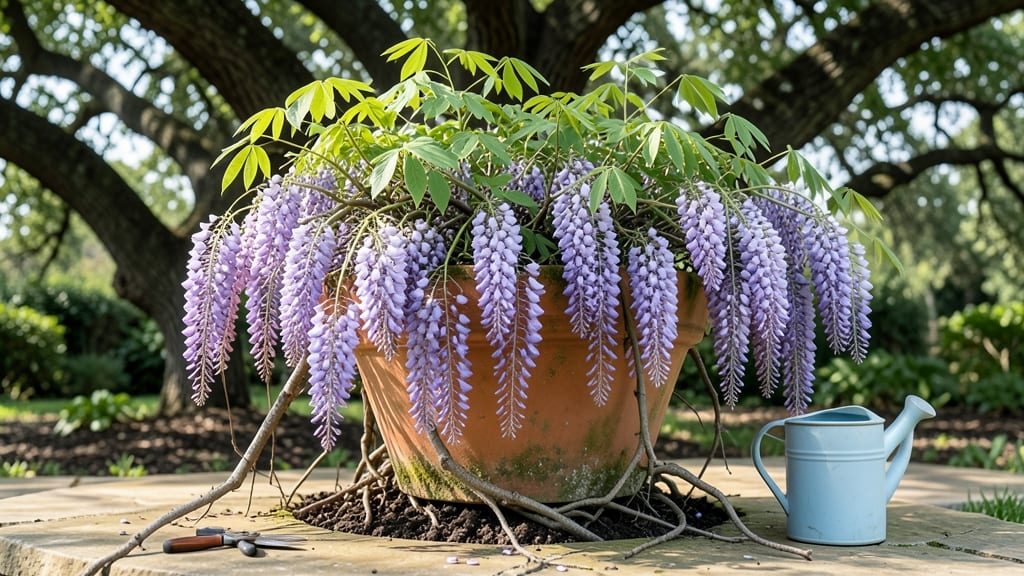
Your wisteria blooming season starts with one critical trick—timing pruning to match your zone. 🌸 I learned the hard way that cutting too late means fewer flowers next year, while pruning too early can stunt growth.
The secret lies in balancing when you trim and where you live, because wisteria blooms vary wildly from zone 5 to zone 9.
Most wisteria varieties burst into lavender-purple cascades in late spring to early summer, but your exact timing depends on your climate. In cooler zones (5-7), expect blooms in May-June after the last frost, while warmer zones (8-9) often see flowers stretching from April through July.
The key is sunlight—wisteria needs 6+ hours of direct light daily to set buds properly.
With the right care, you'll transform your trellis into a romantic floral waterfall that lasts weeks. Prune right after blooming (not in fall!), fertilize in early spring, and watch as new growth emerges stronger.
Even my first-year wisteria produced enough blooms to fill the air with that signature sweet fragrance by June.
This method works for both spring-blooming (like 'Amethyst Falls') and summer-blooming varieties (like 'Prolific'). The same principles apply whether you're training vines on an arbor or letting them climb a fence. Here's how to make every season count for more spectacular blooms.
📚 In This Guide
- What you need
- Instructions
- Tips and common mistakes
- Wrapping up and next steps
What you need
- ● Wisteria plants: Choose Wisteria sinensis (Chinese) or Wisteria floribunda (Japanese) varieties. For mature plants (10+ years), budget $50–$200+ per specimen; younger saplings (3–5 years) cost $30–$80. Pro tip: 💡 Buy from reputable nurseries like Wisteria Gardens or local specialty growers.
- ● Support structure: Arbors/trellises: 8–12 ft tall, galvanized metal or cedar (avoid pressure-treated wood). Price: $100–$300.
- ● Strong branches or pergolas: For climbing varieties (ensure diameter ≥ 4 inches for stability).
- ● Soil amendments: Composted manure or worm castings (5–10 lbs per plant).
- ● Bone meal (1–2 lbs) for phosphorus (boosts blooms).
- ● Mulch (3–4 inches of wood chips or pine straw).
- ● Pruning tools: Bypass pruners (for clean cuts).
- ● Loppers (for thicker branches, 1.5–2.5 inch capacity).
- ● Saw (for stubborn branches, 10–12 inch blade).
- ● Fertilizer: Balanced 10-10-10 or slow-release wisteria-specific formula (1 lb per plant).
- ● Watering supplies: Drip irrigation kit or 5-gallon watering can (for deep root soaking).
- ● Plant ties or soft garden twine (to guide young vines).
- ● Copper tape (1-inch width) to deter borers or pests.
- ● Soil pH test kit (ideal range: 6.0–7.0; adjust with lime or sulfur if needed).
- ● Slow-release bloom booster (e.g., Fish emulsion, 1 quart per plant in spring).
- ● Photographs of your wisteria’s growth stages (to track progress!).
How to time wisteria blooms for stunning lavender-purple displays
Mastering wisteria's blooming cycle transforms your trellis into a fragrant purple waterfall—here's how to sync growth with nature's timing.
🌱 Step 1: Prune Last Season's Growth to Stimulate New Blooms
Start in late winter or early spring, before buds swell, by cutting back last year's growth to 3-5 buds from the base. This forces energy into new shoots that will produce next year's flowers. I always use clean, sharp pruners to avoid tearing bark—wisteria heals slowly, and jagged cuts invite disease.
Look for thick, woody stems that flowered last season. These are your "old wood," and they won't bloom again. New growth emerges from the buds closest to the trunk, so leave those intact. If your wisteria is young (under 3 years), prune lightly—just remove dead or crossing branches—to encourage establishment.
☀️ Step 2: Provide Full Sun and Consistent Moisture
Wisteria craves 6-8 hours of direct sunlight daily for optimal blooming. Plant in a location where it gets morning sun and afternoon shade if your climate is hotter than 85°F. I've seen wisteria in partial shade still bloom, but the flowers will be sparse and less vibrant.
Water deeply once a week during the first growing season to establish roots, then taper to every 10-14 days once established. The key is consistent moisture—wisteria roots run deep, but they hate drought stress. You'll know it's thirsty when the leaves curl slightly at the edges. Mulch with 2-3 inches of organic matter to retain moisture and regulate soil temperature.
✂️ Step 3: Summer Pruning to Encourage Next Year's Flowers
After blooming, prune again in late summer to shape the plant and prepare for next year. Cut back this year's growth by one-third, focusing on long, leggy stems. Remove any suckers growing from the base—they drain energy from the main plant. I always prune just above a leaf node where new growth can emerge.
This summer pruning might seem counterintuitive—you're removing flowers! But it redirects the plant's energy into stronger stems and more buds for next spring. If you skip this step, your wisteria will produce fewer, smaller blooms the following year. Watch for new shoots emerging from the pruned nodes—these are your future flowering stems.
🌿 Step 4: Fertilize for Vibrant Blooms
Feed your wisteria in early spring with a balanced 10-10-10 fertilizer (or organic equivalent) to support new growth. I use ½ cup per year of plant age (e.g., ½ cup for a 1-year-old, 1 cup for a 2-year-old). Fertilize again in early summer with a low-phosphorus, high-potassium blend (like 10-10-20) to encourage flowering.
Avoid over-fertilizing—wisteria grows aggressively, and too much nitrogen leads to leafy growth at the expense of flowers. You'll see the difference in leaf color: dark green with a glossy sheen means it's happy and well-fed. If leaves turn yellow, you're overdoing it. Water thoroughly after fertilizing to prevent root burn.
Tips & tricks for perfect wisteria blooming season
Here's what nobody tells you about making wisteria bloom like a dream—these tricks will help you avoid the most common pitfalls.
Pruning Precision: When you're cutting back to 3-5 buds in Step 1, focus on selecting the healthiest, most outward-facing buds near the trunk. These will produce the strongest new growth and the most flowers. I've seen people accidentally cut too close to the trunk—always leave at least ½ inch of stem below your cut to prevent disease. Also, if your wisteria is young (under 3 years), remember to go extra light—just remove dead or crossing branches rather than aggressive pruning.
Sunlight Strategy: Those crucial 6-8 hours of sunlight in Step 2 are non-negotiable for vibrant blooms, but here's the secret: morning sun is more important than afternoon. If you must choose, prioritize east-facing exposure over west. In hotter climates (above 85°F), I've found that providing afternoon shade with a sheer curtain can actually increase flower production by preventing heat stress. Watch for leaves curling at the edges—that's your plant's way of saying "I need more water!"
Summer Pruning Secret: The one-third reduction in Step 3 might seem drastic, but timing is everything. Do this pruning after the main bloom cycle but before new buds form—typically in late summer. I've learned the hard way that pruning too early removes potential blooms, while pruning too late can stimulate too much new growth that won't mature before winter. Look for those leaf nodes—they're like little promise buds for next year's flowers.
Fertilizer Fine-Tuning: That ½ cup per year of age in Step 4 is a great starting point, but here's how to make it even better: split that first spring feeding into two applications, one in early spring and one in late spring. This gives your wisteria a steady nutrient supply without overloading it. And for that second summer feeding, I've had great success with a fish emulsion (high in potassium) instead of synthetic blends—it gives the flowers that extra pop of color.
Pro Tips for Wisteria Blooming Season
- Here's what nobody tells you about making wisteria bloom like a dream—these tricks will help you avoid the most common pitfalls.
- Pruning Precision: When you're cutting back to 3-5 buds in Step 1, focus on selecting the healthiest, most outward-facing buds near the trunk.
- Sunlight Strategy: Those crucial 6-8 hours of sunlight in Step 2 are non-negotiable for vibrant blooms, but here's the secret: morning sun is more important than afternoon.
Frequently asked questions
Got questions about wisteria blooming season? You’re not alone—these stunning vines captivate (and confuse!) gardeners with their timing and care. Here are the answers to the most common queries to help you plan your lavender-purple dreams.
When is the best time to plant wisteria for optimal blooms?
Plant wisteria in early spring (March–April) or fall (September–October) in USDA zones 5–9. Avoid transplanting during dormancy (winter) or peak heat (summer). Young vines need 3–5 years to bloom—patience pays off with those iconic cascades! Pro tip: Choose a location with full sun (6+ hours/day) and sturdy support (trellises or arbors) to mimic their natural climbing habits.
Why isn’t my wisteria blooming yet?
Wisteria often skips blooms due to immature age, poor pruning, or lack of sunlight. If your vine is 3+ years old but still bare, check these fixes:
- Prune aggressively in late winter to encourage new growth (cut back ⅓ of last year’s stems).
- Ensure it gets 6+ hours of sun—shady spots delay blooms.
- Fertilize in early spring with a balanced, phosphorus-rich formula (e.g., 10-10-10).
Can I grow wisteria in my climate? What’s the ideal USDA zone?
Wisteria thrives in USDA zones 5–9, but varieties vary:
- American wisteria (Wisteria frutescens): Hardy to zone 4 (cold-tolerant but slower to bloom).
- Japanese wisteria (Wisteria floribunda): Prefers zones 6–9 (delicate in deep freezes).
- Chinese wisteria (Wisteria sinensis): Zones 5–9 (fast-growing but invasive—plant with caution!).
For cooler climates (zones 3–4), opt for American wisteria or grow in containers and overwinter indoors. Pro tip: Mulch heavily in winter to protect roots from temperature swings.
How do I extend wisteria’s blooming season?
Wisteria’s blooms are short-lived (1–2 weeks per flush), but you can coax more flowers with these tricks:
- Prune after blooming (late spring/early summer) to remove spent flowers and encourage a second, smaller flush in late summer.
- Water deeply 1–2x/week during dry spells—stress reduces blooms.
- Choose early-blooming varieties like ‘Amethyst Falls’ (Japanese) or ‘Blue Moon’ (American) for prolonged color.
Bonus: Deadhead faded blooms to redirect energy into next year’s flowers!
What’s a low-maintenance alternative to wisteria?
If wisteria’s invasiveness or upkeep scares you off, try these climbing, fragrant alternatives with easier care:
Plant
Bloom Time
USDA Zone
Care Level
Clematis (e.g., ‘Jackmanii’)
Spring–fall (varies by type)
4–9
Moderate (prune based on group)
Honeysuckle (e.g., ‘Lemon Cream’)
Summer–fall
4–9
Low (drought-tolerant)
Passionflower (e.g., ‘Maypop’)
Summer–fall
6–10
Low (self-cleaning)
These vines offer color, fragrance, and fewer headaches—perfect for beginners!
Wrapping up and next steps
The wisteria blooming season is a breathtaking spectacle that rewards patience and care—whether you're admiring nature’s lavender-purple cascades or nurturing your own vines. By timing pruning, fertilizing, and watering just right, you’ll unlock stunning, abundant blooms year after year.
Now that you’re armed with the best tricks, why not plan your next steps? 🌸
- Mark your calendar for next year’s blooming window based on your hardiness zone.
- Experiment with a new variety—like Amethyst Falls or Royal Purple—to add drama to your garden.
- Share the magic! Snap photos of your wisteria in full glory and inspire others to grow their own.
Your garden (and future visitors) will thank you! 🌿✨